
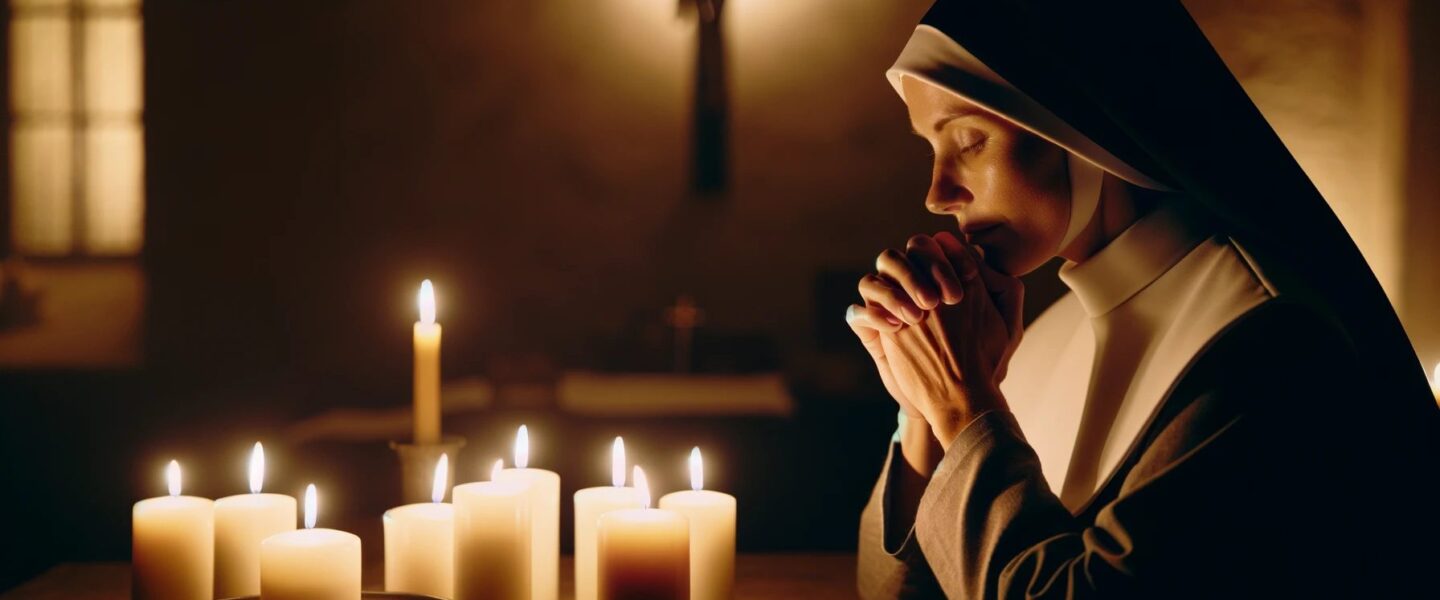
In the month the Church dedicates to the Holy Souls, the account of a 15th-century mystic who, according to her confessor, was led by the Archangel Raphael to see the souls being purified — and to understand how much our prayers matter to them.
November is the month of the Holy Souls. It begins with All Saints and All Souls, and for the rest of the month the Church invites us to remember our dead in a special way and to pray for them. It is also the time of year when a question many of us carry quietly comes back: what happens to those who die in God’s friendship but are not yet ready for heaven?
Among the saints who left a description of purgatory, one of the most detailed comes from a woman who spent her whole life in Rome, between her family, the poor and prayer: St. Frances of Rome.
Who was St. Frances of Rome?
Francesca Bussa was born in Rome in 1384 and died there in 1440. At her father’s wish, she married Lorenzo Ponziani, a young nobleman from Trastevere, when she was barely a teenager, and she lived as a wife and mother through years of war, famine and plague. She lost two of her three children, her husband and her family’s property, and she never stopped caring for the poor of Rome.
In 1425, together with a group of companions, she consecrated herself to the Blessed Virgin as an oblate at the church of Santa Maria Nova, in the Roman Forum. In 1433 the small community moved into the house at Tor de’ Specchi, where the Oblates of St. Frances of Rome still live today. After her husband’s death, Frances joined them and became their superior.
Tradition holds that throughout her life an archangel stood at her side as her guardian, visible to her eyes. She was canonized in 1608, her feast is celebrated on March 9, and she is honored as the patron saint of drivers.
Where the account comes from
We know her visions thanks to Father Giovanni Mattiotti, a Roman priest who was her confessor from 1429 until her death. He asked her, under obedience, to tell him her visions in every detail, and he wrote them down. Those Latin texts have been studied for centuries and are now available in a critical edition.
According to her confessor’s account, Frances was taken in spirit first to hell and then to purgatory, accompanied by the Archangel Raphael. She called purgatory the “kingdom of pain,” but its pain is very different from the pain of hell. There is no despair there, because every soul in purgatory is already saved and is only waiting to be made pure.
The regions of purgatory in her vision
In the description recorded by Mattiotti, purgatory is divided into several regions, according to how serious the faults still to be atoned for are.
In the highest region are the souls being purified of lesser sins. Their greatest suffering is being kept from God: they long to see Him and cannot yet.
Support the Project
Support the Mission
Christian Way Center grows thanks to the support of people like you. Every contribution makes a difference.
Support the Mission →In the middle region are souls with graver faults, divided into three zones. The first is like a marsh of frozen water, the second like a pool of pitch and boiling oil, the third like a burning foam that looks like molten silver and gold. In the vision, thirty-six angels appointed by God immerse the souls in these pools, but they do so with great respect and compassion.
The lowest region borders on hell and is crossed by a fire that reaches to the very bones. Frances distinguishes it from the fire of hell for one precise reason: this fire purifies and sanctifies. Here too there are three zones of increasing suffering. In the first are lay people; in the second, clerics not yet ordained, religious and lay brothers; in the third, the most painful, priests and bishops, because they received more graces and will have to give a greater account of them.
The part that concerns us
The vision does not stop at suffering. According to the account, Frances saw that the prayers, acts of contrition and penances offered by the faithful truly reach the souls in purgatory. They help the soul they are offered for, and the other souls too, because the members of the Church are bound together in a real communion. And if the soul we are praying for is already in heaven, nothing is lost: the good we offer passes on to the souls who are still suffering.

This is what the Church has always taught. The Catechism explains that those who die in God’s grace but are still imperfectly purified are assured of their eternal salvation, and after death undergo a purification so as to enter the joy of heaven. It also recalls that from the earliest centuries Christians have honored the memory of the dead and offered prayers for them, above all the Holy Sacrifice of the Mass, as well as almsgiving, indulgences and works of penance.
How to read this vision
The visions of the saints are private revelations: the Church does not ask us to believe them as articles of faith. The images of the frozen marsh, the boiling oil or the golden foam are the language a 15th-century mystic used to describe something beyond words. What remains, beyond the images, is the heart of the story: purgatory is a place of hope, God purifies with love, and we can help those who have gone before us.
That is why St. Frances still speaks to us today, especially in November. She reminds us that our loved ones who have died are not far from us, and that a prayer, a Mass offered for them or an act of charity done in their name has a value we cannot see, but that is real.
We at Christian Way Center invite you to remember your loved ones in these days and to pray with us for all the Holy Souls in purgatory:
Eternal rest grant unto them, O Lord, and let perpetual light shine upon them. May they rest in peace. Amen.
Sources: Giovanni Mattiotti (Latin treatises, critical edition by A. Bartolomei Romagnoli); Carlo Acutis Association; ACI Prensa; Dizionario Biografico degli Italiani; Catechism of the Catholic Church, nos. 67 and 1030-1032.
Related Articles

Miracle in Iran: Why thousands of Muslims see Jesus in dreams? (Documented Proof)
Iran is currently one of the most dangerous places in the world to be a Christian. Owning a Bible is a crime, churches are sealed with padlocks, and...

Our Lady of Champion: the Miracle of the Fire That Stopped at Prayer
There’s a kind of fear that doesn’t feel like ordinary fear, the moment you realize nature isn’t just “acting up,” it’s coming straight for you. Not with distant...

Native Americans knew Jesus before missionaries arrived: The Texas Mystery
July 1629. The Texas Desert. The history of Christian missions is filled with heroism, sacrifice, and martyrdom. We are used to reading about brave friars crossing impenetrable jungles,...