

In September 1224, on Mount La Verna in the hills of Tuscany, Francis of Assisi had withdrawn for a long fast and retreat in honor of St. Michael the Archangel. One morning, close to the feast of the Exaltation of the Holy Cross, he had a vision. When it ended, the wounds of the crucified Jesus had appeared on his hands, his feet and his right side. It is the first recorded case of the stigmata in the history of the Church.
That story carries special weight this year. 2026 marks 800 years since the death of St. Francis, and Pope Leo XIV has proclaimed a special Year of St. Francis that runs until January 10, 2027. We at Christian Way Center told the story of the stigmata in a video from our Deo Gratias archive. Here is what happened on La Verna and what it can mean for us.
The vision of the crucified Seraph
The earliest account comes from Thomas of Celano, Francis’s first biographer. He writes that Francis saw a man like a Seraph, with six wings, hovering above him. The figure’s hands were stretched out and his feet joined, fastened to a cross. Two wings rose above his head, two were spread for flight, and two covered his body.
Francis, Celano says, was filled with wonder. He felt deep joy at the gentle, beautiful gaze the Seraph turned on him, yet he was grieved to see him nailed to a cross. While he was still trying to understand what the vision meant, the marks of nails began to appear in his own hands and feet.
Wounds that looked like nails
Celano’s description is remarkably precise. In the palms and on the tops of the feet there were round marks like the heads of nails, and on the other side something like the bent-over points, formed from the flesh itself. His right side was open as if pierced by a lance, and it often bled, staining his habit.
Francis spent the rest of his life trying to hide these marks. He kept his hands inside his sleeves and covered his feet. Only a few close companions knew. After his death, Brother Elias, then leading the order, announced the news to the friars in a letter, and many were able to see and touch the saint’s wounds.
The note he wrote on the mountain
During those days on La Verna, Francis wrote a small sheet of parchment in his own hand for his companion, Brother Leo. On one side are the “Praises of God Most High,” a prayer of pure adoration. On the other is a blessing for Leo. That little note, known as the chartula, is still kept today in the Basilica of St. Francis in Assisi. After an experience of such pain, the first words from his pen were words of praise.
Support the Project
Support the Mission
Christian Way Center grows thanks to the support of people like you. Every contribution makes a difference.
Support the Mission →Why the stigmata?
People often ask why God would allow such a good man to carry so much pain. The Church sees the stigmata as a sign of love. All his life Francis had longed to resemble Jesus, poor and crucified, and in the end his own body became an image of the Passion. St. Paul had written: “I bear the marks of Jesus on my body” (Galatians 6:17).
After Francis, the Church has known other stigmatized saints, from St. Catherine of Siena to St. Padre Pio. In every case the Church proceeds with great caution, because what matters is not the extraordinary sign but the holiness of the life. Franciscans remember the stigmata of St. Francis every year on September 17.


Eight hundred years later
Francis died on the evening of October 3, 1226, at the Portiuncula near Assisi. He was 44. Pope Gregory IX canonized him just two years later, in 1228. This year, for the 800th anniversary of his death, Italy restored October 4 as a national holiday in his honor for the first time since 1977.
We at Christian Way Center believe the stigmata speak to anyone carrying invisible wounds today: an illness, a loss, a betrayal. Francis did not go looking for suffering, but he united it to the love of Christ. And he came down from La Verna praising God.
Let us pray together
Lord Jesus, on Mount La Verna You marked the body of St. Francis with the signs of Your Passion. Look on the wounds we carry in our hearts. Teach us to love You as he did, in simplicity and joy, even when the cross is heavy. Through the intercession of St. Francis of Assisi, give us Your peace and turn our pain into praise. Amen.
Related Articles

Our Lady of Guadalupe Tilma: The Hidden Mysteries That Defy Time and Science
Our Lady of Guadalupe Tilma: The Extraordinary Signs That Speak to the Heart It sounds like a scene from a movie, yet it is real history. It is...
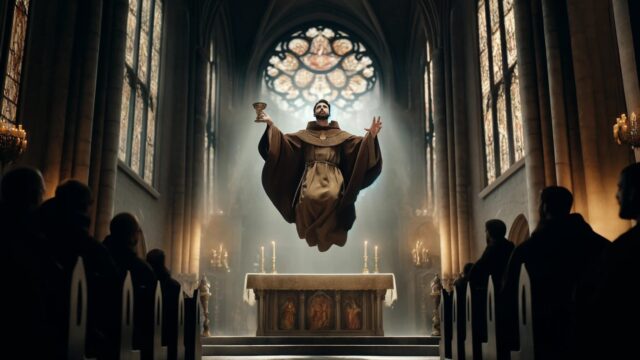
St. Joseph of Cupertino: The Friar Who Rose Into the Air Before Popes and Princes
Turned away by convents and slow at his studies, Joseph of Cupertino became the “flying saint.” Hundreds saw his ecstasies, including a pope and a Lutheran prince who later became Catholic.

Prayer to Saint Rita for Impossible Cases
There are moments when, humanly speaking, we can no longer see a way out.An illness that does not heal, a divided family, a job that never comes, a...