
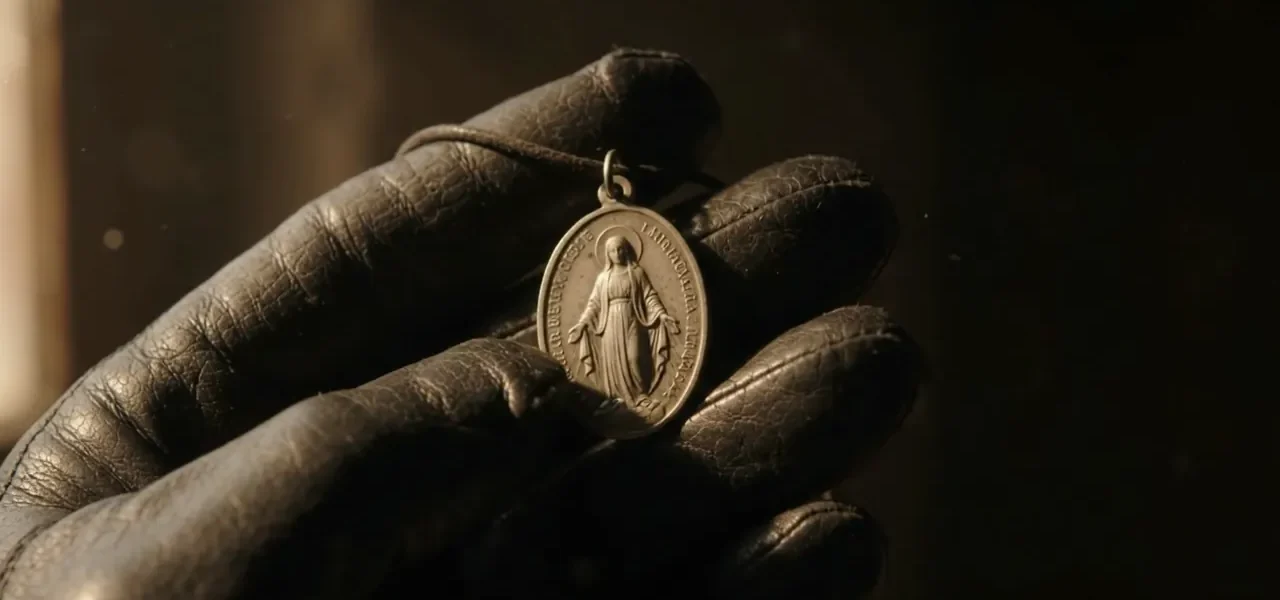
On November 27, 1830, at about half past five in the afternoon, a 24-year-old novice was praying in the chapel of the Daughters of Charity at 140 Rue du Bac in Paris. Her name was Catherine Labouré. By her own account, the Virgin Mary appeared to her that evening and asked her to have a medal made. Today that medal, which ordinary people quickly began calling “miraculous,” has spread across the world by the hundreds of millions.
Yet for 46 years almost no one knew who the nun was who had seen Our Lady. Catherine spent the rest of her life caring for elderly men at a hospice on the edge of Paris and never told. With the feast of Our Lady of the Miraculous Medal coming this Friday, November 27, we at Christian Way Center look back at her story and at the message Mary entrusted to that small medal.
The night a child woke her up
Catherine was born on May 2, 1806, in Fain-lès-Moutiers, a farming village in Burgundy. She lost her mother when she was nine. She entered the novitiate on Rue du Bac in April 1830, and a few months later, on the night of July 18, the eve of the feast of St. Vincent de Paul, the first extraordinary event took place.
In her written account, Catherine says she was awakened by a child dressed in white, whom she understood to be her guardian angel. The child led her to the chapel, where the Virgin sat down in the chair of the spiritual director. Catherine knelt beside her and rested her hands on Mary’s lap. Our Lady spoke with her for a long time and told her that God wanted to give her a mission. That chair is still in the chapel today, and pilgrims stop to pray in front of it.
The medal shown on November 27
The second apparition came on November 27, a Saturday, the eve of the First Sunday of Advent. Catherine saw the Virgin standing on a globe with her arms open. Rays of light streamed from her hands toward the earth. Around the figure, golden letters formed a prayer: “O Mary, conceived without sin, pray for us who have recourse to thee.”
Then the image turned, and Catherine saw the back of the medal: the letter M topped by a cross, and beneath it two hearts, the Heart of Jesus crowned with thorns and the Heart of Mary pierced by a sword, all surrounded by twelve stars. According to Catherine’s account, Mary asked her to have a medal struck on this model and promised that those who wore it with confidence would receive great graces.
The rays that never reached the ground
One detail in her account still stops readers today. Catherine noticed that some of the gems on Mary’s rings gave off no light. When she asked why, Our Lady answered that those were the graces people forget to ask for.
This may be the heart of the Rue du Bac message. The graces are already prepared, but many are left unclaimed because no one asks. No complicated prayer is needed. The words on the medal are a single line that anyone can repeat in a hard moment.
The cholera epidemic and a new name
Catherine’s confessor, Fr. Jean-Marie Aladel, did not believe her at first and told her to put it out of her mind. But for two years he watched the young sister go on living with simplicity and obedience, and in the end he brought the request to the Archbishop of Paris, Hyacinthe-Louis de Quélen, who approved it. The first medals, about two thousand of them, were delivered at the end of June 1832.
That same year, cholera swept through Paris and killed more than twenty thousand people. The Daughters of Charity handed out the medals to the sick, and accounts of healings and conversions began to pour in. It was the people who named it the Miraculous Medal. Within a few years millions had been distributed, and Pope Gregory XVI kept one at the foot of the crucifix on his desk.
Support the Project
Support the Mission
Christian Way Center grows thanks to the support of people like you. Every contribution makes a difference.
Support the Mission →In 1842 the medal became tied to the most famous conversion of the century: Alphonse Ratisbonne, a Jewish banker from Strasbourg who had accepted it almost as a dare, said he saw the Virgin in the Roman church of Sant’Andrea delle Fratte exactly as she appears on the medal. St. Bernadette Soubirous was also wearing one before her visions at Lourdes.
The saint of silence
In 1836 the archbishop opened a formal inquiry into the apparitions and asked to question the visionary. Catherine refused to appear. She wanted no one to know who she was, and only her confessor knew her name. By then she had been sent to the Hospice of Enghien in Reuilly, a working-class district on the edge of Paris, where for more than forty years she cared for elderly men.
Her fellow sisters wondered who the sister of the medal could be, and some suspected Catherine, but she never said a word. She spoke openly to her superior only in 1876, a few months before she died. She passed away on December 31 of that year, at the age of 70.


In 1933, ahead of her beatification, her body was exhumed and, according to reports at the time, found intact after 57 years in the grave. Pope Pius XI beatified her on May 28, 1933, and Pope Pius XII canonized her on July 27, 1947. Pius XII liked to call her “the saint of silence.” Today her body rests in a glass reliquary beneath the side altar of the Rue du Bac chapel, a few steps from where she saw the Virgin.
What her story says to us now
Catherine’s life runs against everything our culture teaches. She received a gift that could have made her famous, and she chose to stay hidden. The message mattered more than the messenger. That is why so many Catholics who live a quiet, ordinary faith, made of daily work and prayer without fanfare, feel close to her.
We at Christian Way Center suggest one simple step for the days leading up to the feast on November 27 and the start of Advent on Sunday. Repeat the prayer of the medal several times a day, and entrust to Our Lady one grace you have stopped daring to ask for. If you have a Miraculous Medal tucked away in a drawer, put it back on.
Let us pray together
O Mary, conceived without sin, pray for us who have recourse to thee. Our Lady of the Rue du Bac, we place in your hands the graces we have forgotten to ask for: healing for the sick, peace in our families, and the return to faith of those who have drifted away. Teach us the humility of St. Catherine Labouré, who served you in silence, and walk with us through this Advent toward your Son, Jesus. Amen.
Sources: J.-M. Aladel, The Miraculous Medal: Its Origin, History, Circulation, Results; R. Laurentin, The Life of Catherine Labouré (1980); Association of the Miraculous Medal; Archdiocese of Paris.
Related Articles

Manna of St. Andrew: the First Apostle and the Miracle that Continues in Amalfi
Is it possible that from the bones of a man who lived two thousand years ago a mysterious liquid still continues to flow? In Amalfi, in the crypt...
Prayer to Saint Rita for Impossible Cases
There are moments when, humanly speaking, we can no longer see a way out.An illness that does not heal, a divided family, a job that never comes, a...

Our Lady of Champion: the Miracle of the Fire That Stopped at Prayer
There’s a kind of fear that doesn’t feel like ordinary fear, the moment you realize nature isn’t just “acting up,” it’s coming straight for you. Not with distant...